
Let's find your future customers, write each one a letter in your voice, and put a stamp on it.
Who this is for

You sell to other businesses, and you are past the first customers who already knew your name.
It works best where one new account is worth chasing. That is most of B2B, and we have published field notes on eight of them: commercial property, renewable energy, accounting, finance, construction, staffing, insurance and logistics.
It is for the founder who knows this would work and will never find the afternoons to do it.
Say you sell community-management software. I find the companies hiring a community manager, starting with the ones advertising the same role for the second time, because a job that will not fill is work someone is already doing badly. Then I write to each off their own posts, adapting one of your case studies to their situation.
It costs less than an intern, and it does not need managing.
Why it works

I have built this channel twice. At Foodora we signed restaurants by hand. At Kaia Health we wrote to doctors. Both companies were acquired.
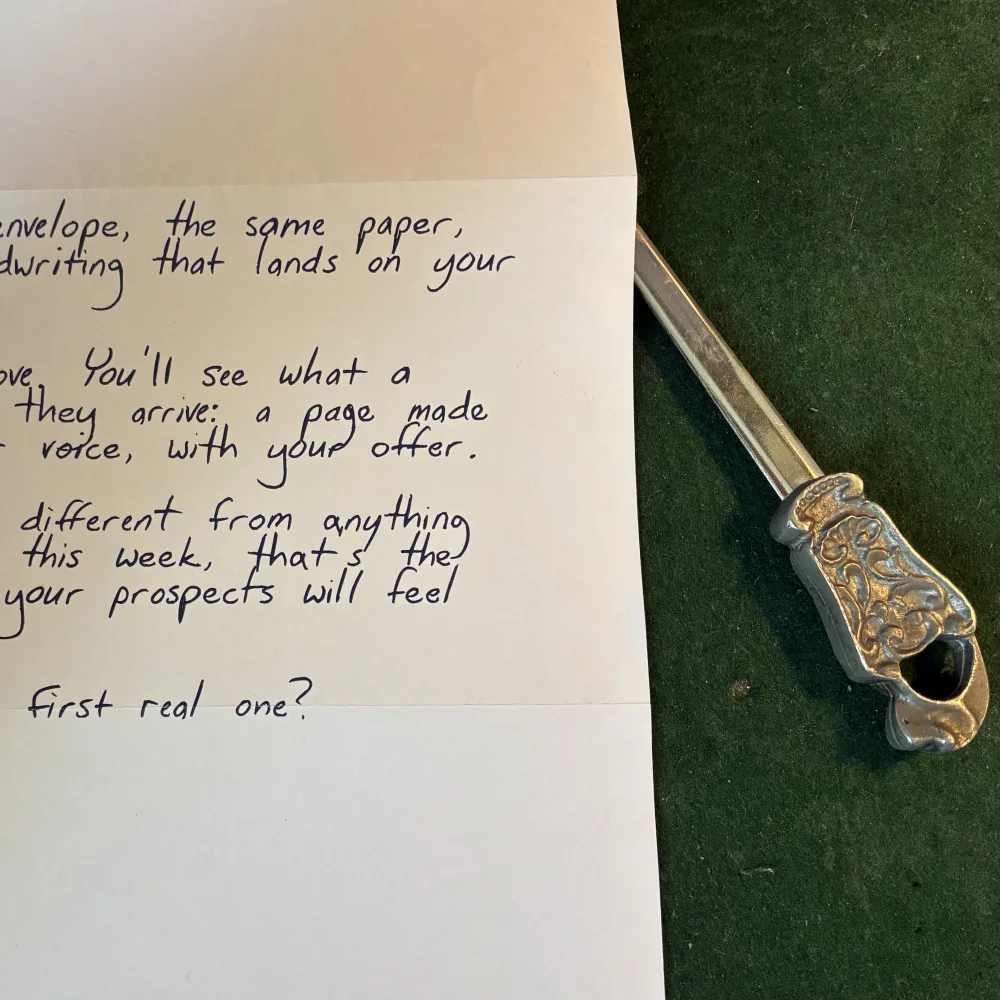
A letter gets opened because almost nobody sends a good one. I research each company off a buying signal and write to that one person. The address is handwritten. The paper has weight.
AI made building the product easy. Distribution is the hard part now. Everyone crowded into the inbox, so I write where a message still gets through: a real letter on the desk.
What happens
Week one: I research who is worth writing to and draft the letters in your voice. You read them. Nothing goes out under your name until you say yes.
Week two: The letters land, then LinkedIn and email follow-ups, because a busy buyer means to reply but needs the nudge. I watch who answers. You step in when someone wants to talk.
Every week: I sharpen the letter on what people actually wrote back, not on a weekly scoreboard. Where the numbers are still too thin to decide, I say so.
Every quarter: A call with me, Manuel, to review the playbook and decide what to try next.
Twenty minutes a week from you. That's the whole job.
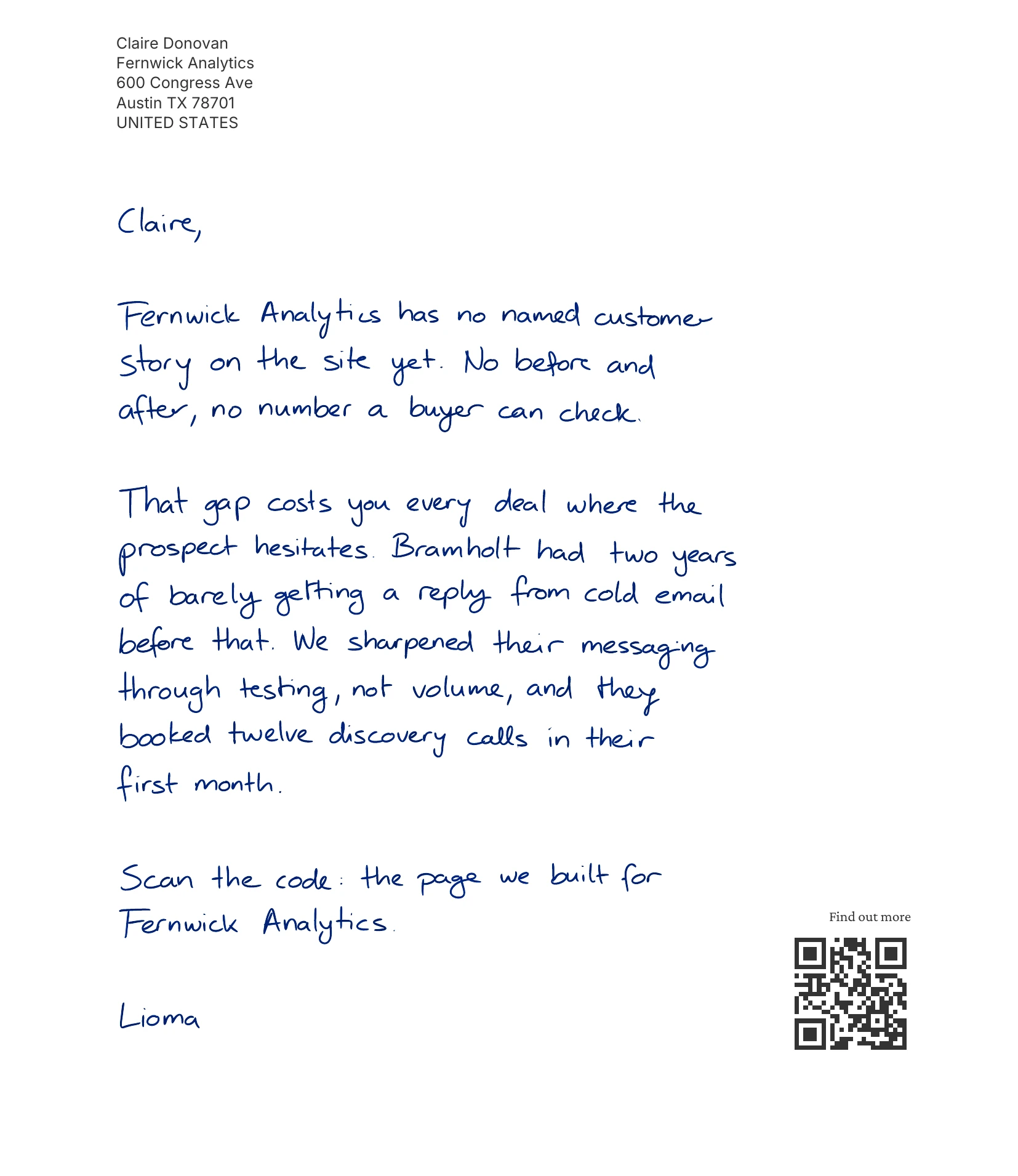
One of my letters. Click to see how it's made.
Before You Ask
Who are you writing to?
I read your website to work out who buys from you, then watch for the ones giving off a buying signal: a new hire, fresh funding, a competitor’s tool on their stack. Those work, and everyone can buy them, so I do not stop there. I also read the public record for the moment before: a role posted a second time, because the first attempt failed, or a company registered last week giving its lawyer’s address, because it has nowhere to sit yet. You see everyone I found and can strike anyone off, or hand me your own list. Then I find the right address and build that company its own page, showing how one of your case studies applies to them. What lands on their desk is a heavy letter about their company, and a QR code to that page.
Will it sound like me?
We write the first letter together: I draft, you nudge it with a line or two of feedback, and I learn from that. You never have to write anything yourself. Then you approve each batch before it goes out. You will adjust a few the first month and almost none by the third, which is how you know it is working.
What can I change?
The list, the letter, and who you will not write to. Strike anyone off the list, or hand me your own. Rewrite any letter, and the edit teaches me rather than applying once. Name a company you will never contact and it stays off. Change the angle whenever you like, though I will tell you what the last one was returning before you do. What you cannot change is a letter after it is posted, which is why nothing goes out without your yes.
How much of my time does this take?
Twenty minutes a week, and the first week is the exception. We write the first letter together: I draft, you tell me what is wrong with it, and I learn from that. After that your week is approving a batch and reading one page on what came back. What you never do is research a company, find an address, write a letter, or remember to follow up on a Tuesday.
Is it really handwritten?
Printed. I'll never tell you otherwise. But printed right: heavy stock, an algorithm that varies every stroke, so no two pages match. I ran it against the machines that hold a real pen, and people picked mine as the more human one. The ink was never the point. The point is a letter written about their company, for one person, that lands on their desk. And when a prospect asks, you have a straight answer: the handwriting is machine-made, the decision to write to them wasn’t. We don’t print that on the envelope, because the handwriting has one job, to get the letter opened. After that, you can say exactly how it came about.
Can I send letters to people who never asked?
Yes, and on firm legal ground on both sides of the Atlantic. In the EU two articles carry it. Article 6(1)(f) is the basis for writing at all: business outreach counts as a legitimate interest, which is why the rules that strangled cold email left the letterbox alone. Article 14 is the duty that rides along with it: because you found them rather than the other way round, the first contact has to say where their details came from and how to stop it. That line is on every letter, and the page behind the QR code takes them off the list in one tap. In the US, a letter to a business office carries no such restriction, and cold email is legal under CAN-SPAM as long as it names you and offers an easy way out. LinkedIn messages stay within the platform's own terms of use. Across every channel: business addresses only, opt-outs honoured, no consumer lists.
What does it cost?
$490 a month, plus tax. Your weekly letters, the research, the follow-ups, the weekly read on what came back. Month to month, no setup fee, no minimum. The useful way to size it is what a first real answer costs: 2 months, 160 letters, and you know whether this channel is worth continuing. Whether it pays comes down to $490 against what a customer is worth to you. Run your own numbers in the calculator below.
How fast do I know if it is working?
Two questions, and they resolve at different speeds. Whether it works: at 20 letters a week, a reply rate starts to mean something once about 48 have gone out and had a fortnight to be answered, so about a month in. Somewhere between week 6 and week 8 that becomes a real read. By the end of it 160 letters are out, 120 have had their fortnight, and you have paid for 2 months. Whether it does not work is dearer, because silence is weaker evidence than a reply: ruling an angle out honestly takes 153 answered letters, about 10 weeks. The 3 follow-ups are what buy that number down, because silence from someone we asked again and again is worth far more than silence from someone asked once. Every week I tell you where on that road you are, so a quiet month reads as a position and not a verdict.
Do I not need hundreds of letters before the numbers mean anything?
Yes for half of it, and the half matters. Proving an angle works takes 48 letters. Ruling one out honestly takes 153, and a milder shortfall takes 361. Good news is cheap and bad news is expensive, and anyone quoting you one number for both is selling something. Two things pay the difference down. Each person is asked up to four times, not once, which lifts the reply rate rather than the count, and when the event is rare that does the same work: someone who opens their page, takes two more follow-ups and still says nothing has answered you as clearly as an email would. And you are not running a poll. A poll pins a percentage to the decimal; you need one decision, whether this buyer and this message clear the floor, and that costs far less evidence. When the honest answer is still “too early”, that is what you get, rather than a small number dressed up as a finding.
How do you decide something is not working?
By counting, with the error rate stated up front. Detection needs a roughly fixed number of expected replies, not a fixed number of prospects, so the prospects you need is that count divided by your reply rate. That is what the follow-ups are for: they do not give us more trials, they raise the rate, which does the same work. Concretely: a standout angle proves itself inside 48 prospects, but at 48 there is no honest way to call anything dead yet, at any threshold. A collapse to a quarter of what a working campaign returns is caught 60% of the time by 110 prospects and 87% by 153. A milder shortfall, half of what a working campaign returns, takes 361. What we cannot do is rank one angle against another at this volume, and we do not pretend to. We accept about a 5% chance of calling a working angle dead to get those catch rates. The ladder, the worked example and the interval we use
What if it doesn't work?
You cancel with a week's notice and keep everything: the target list, the letters, and the record of which message got answered and which got silence. That travels into every channel you run next.
Do the Math
Estimated return
Lifetime return on what you pay us. Winning one customer costs about $544. The sliders below hold our estimates, so move them to yours.
5% is what we call a working campaign. Our bar, not an industry average.
The multiple is a rate, so it holds at any length and says nothing about how long. Here is how long: 20 letters a week for 6 to 8 weeks, which is 2 months of the plan. By the end 160 are out and 120 have had their fortnight, enough for a good read on whether this channel works for you. Calling an angle dead takes longer, about 10 weeks, because silence is the expensive answer.
How we find them
The usual signals work. A company raised money, hired someone, put your competitor’s tool on their stack: all of it is worth writing about, and we do. The trouble is that everybody who bought the same data this morning is writing about it too, so your letter is not the first to say so.
We look for the moment before. A foreign company registers a Swiss branch and gives its lawyer’s address, because it does not have one yet. It needs an office and has not started looking. The register publishes that the day it happens, for free.
The best signal we found is not about the company at all. Someone files a building project at the address where you are registered. You are not deciding whether to move. Your landlord decided.
We work one industry at a time, and we write down what fails. Asked for landowners in eastern Germany, a general prospecting tool returned energy buyers, a farm we could not confirm exists, and a direct competitor. So we found them by hand, off the zoning plans of the parishes next door. Eight industries so far. Every claim links to the record it came from.
- A company that has just registered has nowhere to sitCommercial real estate
- The signal belongs to the neighbourhood, not the companyRenewable energy
- Six per cent of one day’s new companies shared a single addressAccounting and corporate law
The other five
- We went looking for a signal and found an addressFinance and banking
- The open-data version had the names removedConstruction and fit-out
- Everyone sells “they are hiring”. The stronger signal is that they failed toStaffing and recruitment
- The obligation is public. The headcount that triggers it is notInsurance and benefits
- The register exists, and it can only answer questions you already knowLogistics and freight
Then we count it honestly
Finding them is half of it. The other half is not fooling yourself about what came back. At 153 letters we call an angle dead at 3 replies or fewer, and whether your number sits above or below that line is arithmetic, not optimism. We wrote down how we decide, including what makes us call our own work a failure.